
Views: 0 Author: Site Editor Publish Time: 2025-12-01 Origin: Site


CMC/RDP/VAE can be used as a water-retaining agent and adhesive in building putty, making putty application easier and more convenient. Shijiazhuang Cellulose Co., Ltd., as a Chinese cellulose company, can provide you with high-quality building-grade chemical powders.
I. Classification by Cementitious Material
1. Cement-based Putty
Uses cement as the main cementitious material, typically combined with additives such as quartz sand, heavy calcium carbonate powder, and water-retaining agents.
Performance Characteristics: High bonding strength, excellent water resistance, high hardness, not prone to aging, and good stability. However, its flexibility is relatively poor, requiring specific moisture levels on the wall substrate during application (it cannot be too dry), and its sanding properties are slightly inferior to gypsum-based putty.
Application Scenarios: Primarily used for exterior walls, kitchens, bathrooms, basements, and other damp areas requiring high water resistance and strength. It is the preferred choice for exterior wall construction.
2. Gypsum-based Putty
Uses building gypsum (calcium sulfate hemihydrate) as the main cementing material, with added retarders, water-retaining agents, and other additives.
Performance Characteristics: It has micro-expansion properties, effectively filling tiny cracks in walls; lightweight, with good sound insulation and thermal insulation; smooth to apply, easy to sand, and produces a fine surface. However, it has poor water resistance and easily softens and powders when exposed to moisture.
Application Scenarios: Primarily used for leveling ceilings and interior walls in dry indoor areas, especially suitable for treating cracks at the junction of concrete slabs, shear walls, and block walls (because its expansion property can offset the stress caused by the inconsistent shrinkage of different materials). Not suitable for use in damp environments.
3. Powder-based Putty (rarely used now)
This type of putty uses high-molecular polymer powder (such as redispersible polymer powder (RDP/VAE)) as the main binder, combined with fillers such as heavy calcium carbonate powder and talc powder.
Performance characteristics: Good environmental performance, strong adhesion, excellent workability, and good sandability. However, its water resistance is generally not as good as cement-based putty, and its cost is relatively high.
Application scenarios: Commonly seen in interior wall projects with high environmental protection requirements, but with the optimization of cement-based and gypsum-based formulations, its market share has gradually shrunk.

II. Classification by Water Resistance and Function
1. Water-resistant Putty
This generally refers to putty that meets national standards and maintains its strength and adhesion after being soaked in water for a certain period. It is mostly cement-based or a specially modified polymer putty.
Performance Characteristics: It has extremely high bonding strength and water and alkali resistance, a long service life, and is not prone to hollowing or peeling. It has high strength after hardening, but sanding is relatively laborious.
Application Scenarios: Mandatory for use on all exterior walls, as well as indoor areas such as kitchens, bathrooms, and shower rooms that are frequently exposed to moisture. In humid southern regions, it can also effectively prevent mold and peeling on indoor walls.
2. General-purpose putty (non-water-resistant putty)
Putty whose water resistance does not meet national standards is typically made primarily of gypsum and base powder (double-flying powder), using pregelatinized starch or carboxymethyl cellulose (CMC) as binders.
Performance characteristics: Low cost, very convenient to apply and sand. However, it has low strength, easily softens and powders when exposed to water or moisture, and has a short service life.
3. Elastic Putty (Crack-Resistant Putty)
High-molecular-weight elastic polymers are added to ordinary putty formulas, giving the paint film a certain degree of elasticity.
Performance Characteristics: Good flexibility, effectively resisting surface cracks caused by substrate cracking, temperature changes, etc., and has a strong ability to cover fine cracks.
Application Scenarios: Mainly used for exterior walls, interior walls with existing cracks or expected cracking, and for treating joints between different building materials.
4. Functional Putty
Putty designed to meet specific needs, such as:
Polishing Putty: Offers an extremely smooth and delicate surface, suitable for "paint-free" finishes, where the putty layer is sanded and used directly as the final surface.
Negative Ion Putty: Contains specific mineral materials that continuously release negative ions, providing some air purification functionality.
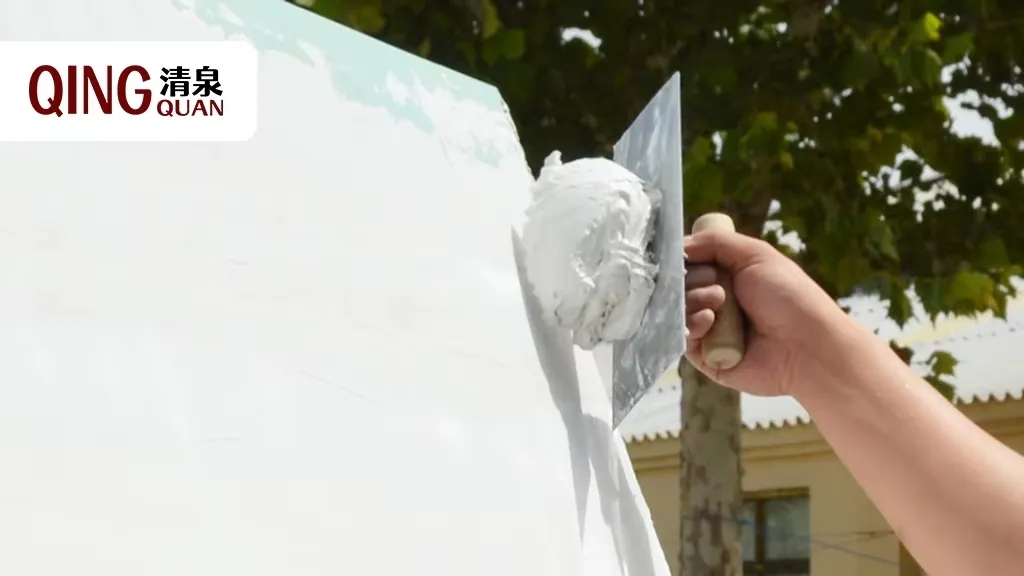
Summary and Selection Recommendations
When choosing putty powder, the principle of "adapting to local conditions" should be followed:
Regarding the area:
Exterior walls, kitchens, and bathrooms: Water-resistant cement-based putty must be selected.
Dry indoor areas (living room, bedroom, study): Gypsum-based putty is preferred for leveling, as its overall performance is superior to traditional non-water-resistant putty. If higher moisture-proofing is required, water-resistant interior wall putty can also be used.
Areas at risk of cracking: Consider using elastic putty as a surface layer or for full application.
Regarding the substrate: Newly built walls have high humidity, so cement-based putty is recommended; gypsum-based putty is recommended for concrete ceilings.
Regarding the finish: If wallpaper is planned, the strength and smoothness of the putty layer are crucial, so high-quality putty should be selected; if latex paint is to be applied, the whiteness and fineness of the putty are important.


