
Views: 0 Author: Site Editor Publish Time: 2025-11-04 Origin: Site


HPMC chemical powder is one of our best-selling products, offering low price and high quality. It can be used as a construction-grade additive in mortar and tile adhesives. Shijiazhuang Cellulose Co., Ltd., a cellulose manufacturer from China, can provide you with ample supply.
Tile adhesive is a mixture composed primarily of cement, supplemented with graded aggregates, water-retaining agents, accelerators, latex powder, and other organic or inorganic additives. It typically only requires mixing with water. Compared to ordinary cement mortar, it significantly improves the bond strength between the finishing material and the substrate, exhibiting excellent anti-slip properties and superior resistance to water, heat, and freeze-thaw cycles. It is mainly used for bonding interior and exterior wall tiles, floor tiles, and other decorative materials, and is widely applicable to interior and exterior walls, floors, bathrooms, kitchens, and other architectural finishing applications.
Besides handling performance and anti-slip properties, the performance of tile adhesive also depends on its mechanical strength and open time. Cellulose ethers in tile adhesive affect not only its rheological properties, such as smoothness during handling and tackiness, but also its mechanical properties and open time. When adhesive powder and cellulose ether coexist in wet mortar, some data show that adhesive powder has stronger kinetic energy to adhere to cement hydration products, while cellulose ether is more present in the interstitial fluid, thus having a greater impact on mortar viscosity and setting time. Cellulose ether has a higher surface tension than adhesive powder, and increased cellulose ether accumulation at the mortar interface is beneficial for forming hydrogen bonds between the substrate and the cellulose ether.

In a wet-mixed state, adhesive powder alters the consistency and smoothness of the system. Adding latex powder improves cohesion, and after drying, it provides adhesion to a smooth, dense surface layer, improving the interfacial interaction between sand, gravel, and pores. With sufficient addition, it forms a film at the interface, giving the tile adhesive flexibility, reducing the elastic modulus, and significantly absorbing thermal stress. It also provides water resistance and buffers temperature variations with material deformation. The flexibility and rigidity of adhesive powder can generally be determined by its glass transition temperature; those below 0 degrees Celsius are considered more flexible. The specific adhesive powder needed in mortar depends on the product's performance characteristics. Tile adhesives require adhesive powders with good adhesion. In wet mortar, as water evaporates, cellulose ethers accumulate on the surface, forming a film within 5 minutes, which slows subsequent evaporation. As more water migrates from thicker mortar layers to thinner ones, the initially formed film partially dissolves, and the migration of water leads to further accumulation of cellulose ethers on the mortar surface. Cellulose provides excellent water retention and workability to freshly mixed mortar, playing a crucial role, especially for wetted areas. It prevents excessive water absorption by the substrate and surface moisture evaporation to ensure successful hydration. Its air-entraining properties reduce the density of tile adhesive, saving material and lowering the elastic modulus of the hardened mortar.
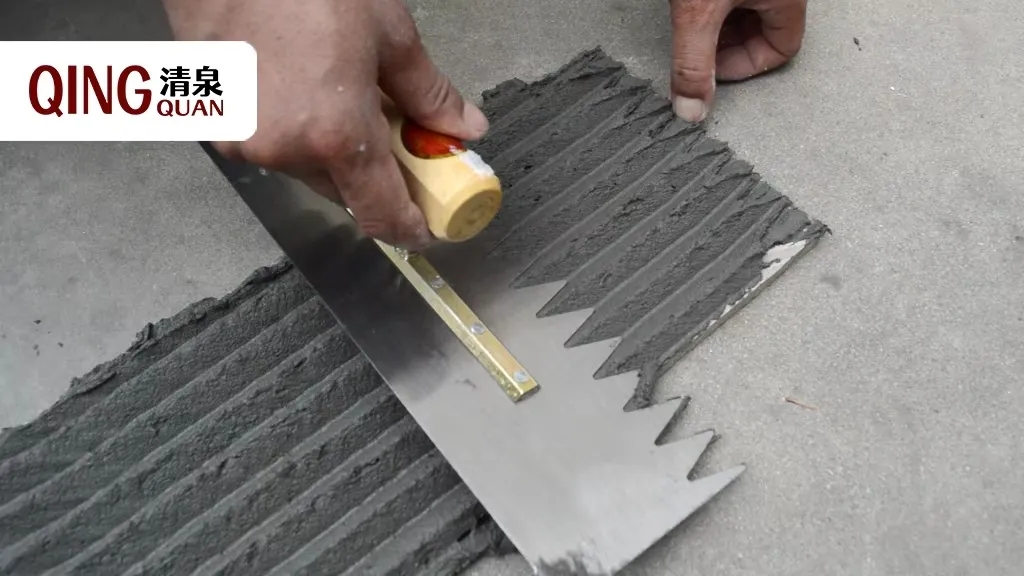
The film formation of cellulose ether on the mortar surface has a significant impact on mortar properties. If the film is too thin, it will be dissolved again, failing to restrict water evaporation and reducing strength. If the film is too thick, the concentration of cellulose ether in the mortar interstitial fluid is high, resulting in high viscosity, making it difficult to break the surface film when tiles are applied. Therefore, the film-forming properties of cellulose ether have a significant impact on open time. The type of cellulose ether (HPMC, HEMC, MC, etc.) and the degree of etherification (degree of substitution) directly affect the film-forming properties of cellulose ether, including film hardness and toughness. Besides imparting the aforementioned beneficial properties to mortar, cellulose ether also slows down the hydration kinetics of cement. This retarding effect is mainly due to the adsorption of cellulose ether molecules on various mineral phases in the hydrating cement system. However, the consensus is that cellulose ether molecules mainly adsorb on hydration products such as C-S-H and calcium hydroxide, and rarely on the original clinker mineral phase. Furthermore, due to the increased viscosity of the pore solution, cellulose ether reduces the activity of ions (Ca2+, SO42-, ...) in the pore solution, further slowing down the hydration process.


